Dify guides, internal links, proof summaries, route decisions, and next steps live on the CREATE SOMETHING site.
Dify Page Portfolio
Each Dify page should have one clear job.
The agency domain owns the canonical explanation, proof, route, and next step. Distribution channels point readers back to that source of truth.
Short notes summarize one idea, point back to the canonical page, and collect reader questions.
Native snippets and demos create reach, but the explanation and next step resolve to the canonical page.
Channel split
Each surface has one job.
Canonical pages, distribution notes, and discovery clips should reinforce each other without confusing the source of truth.
Dify guides, internal links, proof summaries, route decisions, and next steps live on the CREATE SOMETHING site.
Short notes summarize one idea, point back to the canonical page, and collect reader questions.
Native snippets and demos create reach, but the explanation and next step resolve to the canonical page.
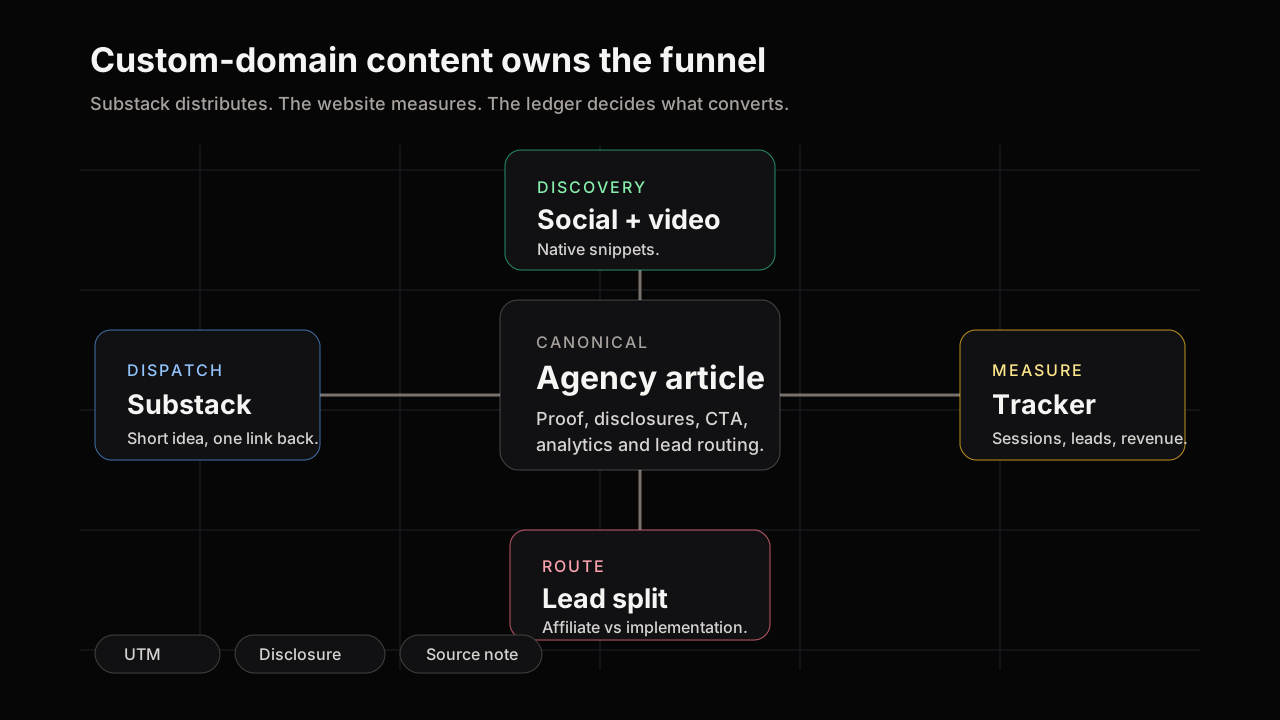
This owned diagram makes the page system visible: long-form proof lives on the agency domain, distribution channels point back to it, and route strength stays measurable.
Created by CREATE SOMETHING for this article.Content cluster
Start with pieces that explain the operating model.
The cluster should teach Dify plus MCP, eval gates, app packaging, delivery evidence, and practical comparison before asking for a purchase.
Targets
The content engine has measurable milestones.
Milestones should measure whether the cluster is clear, connected, and strong enough to stay indexable.
Every page has a clear job, internal route, CTA, and evidence hook.
Each support page links back to the Dify pillar and one next action.
The portfolio scores route strength, schema, internal links, copy quality, and sitemap state.
Thin, stale, duplicate, or off-language pages get routed, repaired, or archived.
Strength
A strong page earns its route.
The registry should make weak, redundant, stale, or off-language pages easy to repair or remove.
The page declares its audience, funnel stage, route decision, and primary action.
The page points to concrete maps, gates, checklists, receipts, or shipping steps.
The page explains workflow, owner, approval, stop point, audit trail, and runbook.
Operating loop
Publish, link, ground, and score.
The content workflow is a control path, not just a publishing cadence.
The agency site owns the explanation, proof summary, route, and next step.
Keep the Dify pillar, control model, eval gates, shipping guide, and comparison connected.
Public language should describe what the workflow does and what evidence exists.
Score the page for schema, links, terms, CTA, sitemap state, and plain language.
Next
Use content to clarify the workflow, not hide it.
If the reader has a concrete Dify workflow, the next step is to map the workflow, tool boundary, approval path, and evidence.
Canonical Own the source of truth
The agency domain carries the proof and next step.
Route Send readers forward
Every page points to the next useful explanation or action.
Measure Track the routing
Scores make weak pages visible before they drift.